
Taking Over a Retail Space: Can You Rekey the Existing Storefront Locks?
TXP Locksmith Team
You have the keys to the space, and no way of knowing how many other people still have one. The locks on a storefront can almost always be rekeyed, which means the previous tenant’s keys stop working while the hardware stays on the door. Where the building runs a master key system, the authorized building key can usually be kept working at the same time.
The rekey itself is the easy part of taking over a space. The part that catches people is working out what they have actually inherited, because the keys handed over at signing are rarely the whole picture.
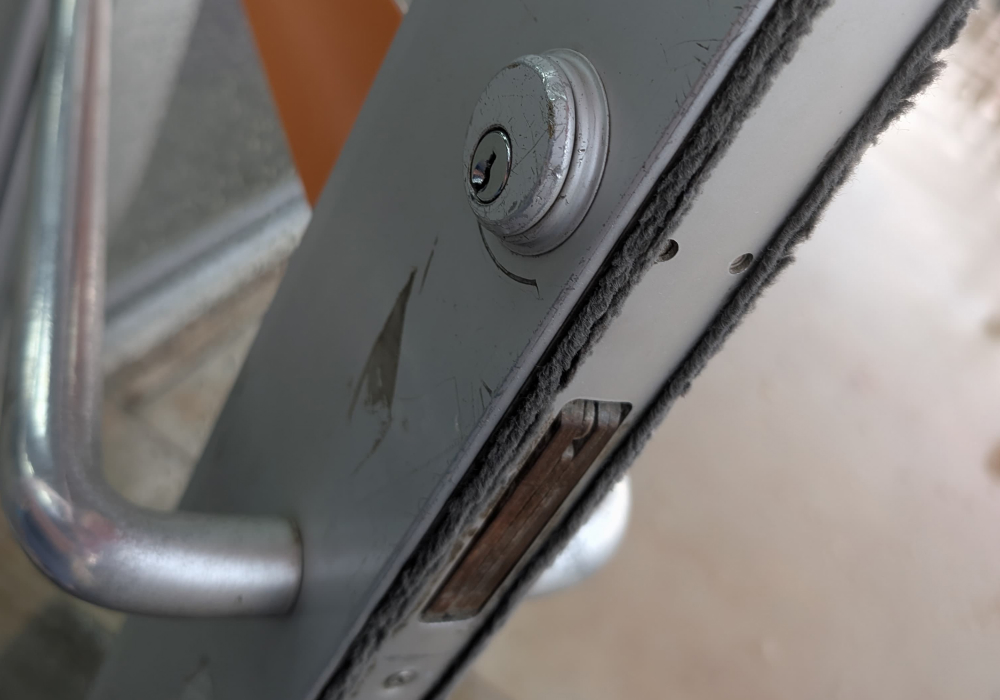
What you inherit along with the space
You cannot assume every copy of the old keys came back. Over a few years of operating, keys get cut for staff, cleaners, suppliers and a contractor who needed access one weekend, and even a business that kept good records cannot account for copies made along the way.
What you are taking on usually includes more than the front door.
- The keys you were handed: often two or three, and usually the front door only.
- The locks themselves: whatever the last business had fitted, in whatever condition they left it.
- Anything keyed alike: if the front and back doors take the same key, every copy of that key opens both.
- Any keypad or connected lock left behind: the previous setup is still in it unless somebody has cleared it.
- Padlocks on gates, roll-down shutters and dumpster enclosures: easy to forget and often the ones with the most copies out there.
- The mailbox or community box key: usually controlled separately, sometimes by the postal service or the property manager.
Count the openings, and note who controls each one
Walk the space with a notepad before anyone quotes you for anything, and write down every door and opening that locks.
A small retail space normally has more than people expect. The front entrance, a rear or service door, a stockroom, a restroom that locks, an electrical or mechanical room, a roll-down gate, a gate to a yard or a dumpster enclosure, and sometimes roof access.
Then mark each one as yours or not. Mechanical and electrical rooms, roof hatches, shared mailboxes and dumpster enclosures are often controlled by the landlord, the building or another authority, and they do not automatically belong on your rekey list. Confirm which openings you are responsible for before anything is booked, and note which ones share a key.
Who may still have a key
Records sometimes exist, and they still cannot account for copies made over the years. The people who could reasonably hold a key to a space that has been open for a while usually include:
- The previous tenant and anyone who worked for them: including staff who left before the business did.
- Their cleaners and regular contractors: access that was given once and never taken back.
- The landlord, the property manager and maintenance: often legitimately, and often more than one person.
- Whoever had a copy cut at some point: a key that says nothing about who made it.
This is why rekeying is the normal first move on a takeover rather than a precaution. It is not about suspecting anybody. It is about knowing which keys work.
Can the locks you inherited actually be rekeyed?
In most cases they can, and here is what decides it.
Standard commercial cylinders are made to be rekeyed. The cylinder or core usually comes out to be worked on, while the lock assembly and the door stay where they are. That covers most storefront entrances, back doors and interior locks.
Three situations change the answer.
A lock that sticks is not automatically a lock that needs replacing. Sticking can come from the key, the alignment of the door, dirt inside the cylinder or another part of the lock entirely, so it gets diagnosed before anyone decides. A cylinder is replaced when its condition calls for it, not because it felt stiff once.
A restricted or patented key system is controlled by whoever set it up, and the key blanks are not freely available. Some of those programs are serviced only by the original dealer and others by any authorized dealer, so the first step is finding out which program it is. Often the answer is a new cylinder or core rather than replacing the lock or the door hardware.
And some storefront hardware takes an unusual cylinder that has to be identified before anyone commits to a plan.
A locksmith can tell which of these you are in by looking at the cylinder and the key.
The landlord’s part in this
Before you book anything, find out two things from the landlord or the property manager.
Does the building run a master key system, and does the lease require them to hold a key? Many commercial buildings are set up so that one building key opens every space for maintenance and emergencies. If yours is one of them, rekeying on your own can take your space off that system, which is not always something the landlord will accept.
None of that stops a rekey. It changes how it is done, because a locksmith can usually rekey your space and keep the authorized building key working. That only happens if everybody knows about it before the work starts.
It is worth asking one more question while you are there. If the building master has ever been lost, that key is a live concern for every space on the system, and it is the landlord’s decision rather than yours.
Access during the build-out
The old advice was to leave the locks until the trades are finished. That is the wrong way around. Security should be dealt with when possession changes, and contractor access planned separately.
- Rekey at possession: the openings you are responsible for, so the keys that work are keys you issued.
- Plan contractor access deliberately: a set number of keys issued to named people, or temporary credentials on an electronic lock, with a date they stop.
- Ask about construction keying: on some hardware a temporary arrangement can be used during the build-out and retired afterward, either by a construction key arrangement or by swapping an interchangeable core when the trades leave.
- Retire that access at handover: the construction arrangement is ended or the cores are changed, and the keys issued to contractors stop working.
- Do not leave the back door for later: rekeying only the front entrance achieves very little if an inherited key still opens the rear or the stockroom.
If you inherited a keypad or a connected lock
Changing the visible codes is not the same as taking ownership of the system.
Find out who holds the administrator credential, what users are registered, whether any schedules are set, and whether an app or an account somewhere still has access. On a connected lock, the previous management can remain in control even after every ordinary code has been cleared. Check the mechanical override as well, and whether a key for it exists.
If nobody can produce the administrator credential, say so when you book. That changes what has to be done, and sometimes the answer is to replace that lock rather than inherit it.
When a rekey is not the whole job
Rekeying deals with which keys work. It does not deal with a lock or a door that is not working properly.
If a door has to be lifted or shoved to latch, if the bolt drags, if the frame around the strike looks damaged or if the previous tenant mentioned a break-in, have the opening looked at rather than just the cylinder. The same visit can cover both, and it costs a great deal less than discovering it on your first Monday.
This is also the moment to decide whether you want to keep using keys at all, because changing the hardware later means paying for the door twice. If codes instead of keys are on your mind, what a storefront door can actually take is worth understanding before you commit.
Checking the work before you call it done
Walk it through with the locksmith rather than signing off on a description of it.
- Test the new keys at every agreed opening: including the ones you only use occasionally.
- Confirm the authorized building access still works: where the lease or the master key system requires it.
- Check each door closes, latches and lets people out: not just that the key turns.
- Record which keys were issued and to whom: on the day, while it is still accurate.
- Where it is available and authorized, confirm the old keys no longer operate the locks: which is worth doing on the openings that matter most.
What to do with the keys you were handed
Keep them until the rekey is done and you have tested the new keys yourself.
After that, hand the old ones back to the landlord or dispose of them, and write down what you did. If one of the keys you were given does not open anything you can identify, mention it when the locksmith is on site. It may be obsolete, it may belong somewhere else in the building, or it may point to an opening you have not found yet.
Expert tip:
Photograph the keys you are handed at the point of handover, with a note of which door each one opens, so there is a record of what was received. Keep those images private and stored securely rather than in a shared folder, since detailed pictures of keys are not something to circulate.
What to do next
Taking over a space is the one moment when getting the locks right is simple, because nothing is in use yet and nobody has settled into a routine. TXP Locksmith rekeys commercial spaces on takeover, checks the hardware you have inherited while on site, and works with a building master key system where one is in place. Call (800) 928-9129 with the number of doors and whether the building has a master key, or read more about how a commercial locksmith in College Station handles rekeys and takeovers.
Frequently Asked Questions
The landlord gave us three keys. Is that all of them?
There may be a record, and a record still cannot account for copies cut over the years. Treat the keys you receive as the keys you have rather than as the keys that exist, and plan the rekey on that basis.
We are still doing the build-out. Should we rekey now or wait?
Rekey when you take possession, then plan contractor access on purpose. Issue a known number of keys to named people, or temporary credentials where the hardware allows it, and end that access when the trades leave. Waiting until the work is finished leaves inherited keys working for weeks, which is the thing you were trying to fix. TXP Locksmith can set that up as two visits, one at possession and one at handover.
The previous tenant left a keypad on the back door. What do we do with it?
Do not assume clearing the codes is enough. Find out who holds the administrator credential, what users and schedules are stored, whether an app or account still has access, and whether the mechanical override key exists. If nobody can produce the administrator credential, replacing that lock is often simpler than inheriting it.
If we rekey, can the landlord still get in?
That depends on the lease and on how the building is set up, which is why it is a conversation to have before the work rather than after. Where the building runs a master key system, a locksmith can usually rekey your space and keep the authorized building key working. Tell TXP Locksmith what the lease says and the work gets planned around it.