
Can You Install a Keypad or Smart Lock on a Glass Storefront Door?
TXP Locksmith Team
Most businesses start thinking about a keypad because they are tired of handing out keys. A code sounds simpler, until somebody looks properly at the front door. A glass storefront is built differently from a solid door, and almost nothing sold for a house will fit it. A keypad can still go on that door, and working out which one takes two steps.
Two things decide what your door can take. The first is what you want the entrance to do during the day. The second is how the door itself is built. Ordering a product before either of those is settled is how businesses end up with hardware that will not fit the door it was bought for.
Decide who needs to get in, and when
Most entrances are a mix rather than one setting, so it helps to go through this by group instead of by scenario.
- Customers and visitors: do they walk in during opening hours, or does somebody let them in each time? That decides whether the door is unlocked during the day or stays secured.
- Staff: do they arrive before the door is unlocked, and does each person need their own way in?
- Regular outside access: cleaners, deliveries and contractors who come at set times or outside hours.
- The end of the day: does the door need to secure itself at a set time, or will somebody always be there to lock it?
A business can need two or three of these at once, and that is normal. The point is to know the full list before looking at products, because a door opened twenty times a day is a different proposition from one opened twice. If the entrance is being rethought as part of a wider look at how a business controls who gets inside, that is worth settling first as well.
What a keypad does, and what a connected system adds
A standalone keypad opens the door when a correct code is entered. A connected system adds software and a network behind it. Both are sold as smart, and they are not the same purchase.
- A separate code for each person: some standalone keypads hold a handful of codes, some hold hundreds, and some have a single shared code. Ask the number before you choose.
- Removing one person without changing everyone’s code: only possible where each person has their own code or credential.
- Schedules, so a code works only at certain times: this needs a programmable or connected system rather than a basic keypad.
- A record of what was used and when: many standalone locks store an event history that is read at the door or pulled off locally, so this does not always mean a connected system. Note that the record shows which code or credential was used, not who used it, and a shared code tells you very little.
- Unlocking remotely: this is the function that genuinely needs a connection, and it is a larger install than a keypad on a door.
One more thing worth asking about separately. A record that a code was accepted does not tell you the door closed and latched afterward. If you want alerts for a door left standing open, or any reporting on the state of the door, that is a different function and it has to be specified.
If nobody needs schedules, records or remote access, a standalone keypad is enough.
How the door is built
Glass storefront doors are not all the same, and the differences change which hardware will physically fit. These are the four you will meet.
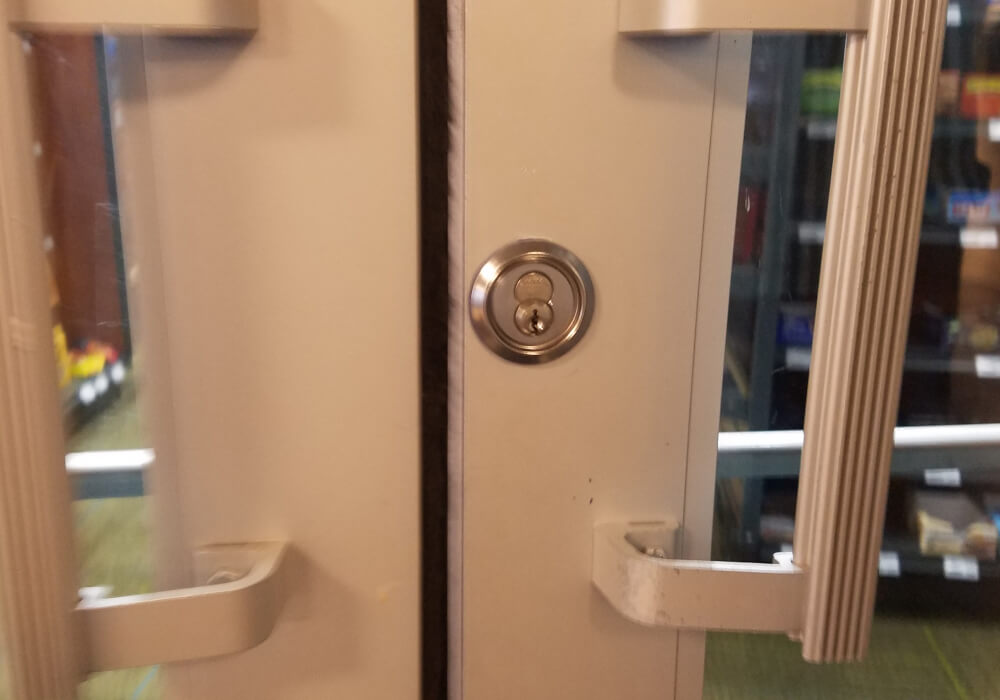
- Aluminum door with a narrow stile: the common storefront door in retail and offices. The upright beside the glass, where the lock sits, is often only an inch and a half to two inches wide, so there is very little material to work with.
- Aluminum door with a medium or wide stile: the same construction with a wider upright. More room usually means more hardware will fit.
- All-glass door with patch fittings: no surrounding frame, just metal fittings clamped at the top and bottom of the panel.
- A solid door with a glass panel in it: wood, steel or hollow metal with a window set into it. This behaves like an ordinary commercial door.
The edge of the door gives you a clue. A band of metal running top to bottom suggests an aluminum or glazed steel door, and glass running to the edge with a metal shoe at the bottom suggests an all-glass panel. Treat those as clues rather than an answer, because a glazed steel door and an aluminum one can look alike from a few feet away and take completely different hardware.
Why a residential smart lock usually will not fit
Most residential smart locks and keypad deadbolts are made for a bored door. They expect a round hole through the face of the door, a second hole through the edge for the bolt, and a set distance between the edge and the center of that bore. Products vary in the thicknesses and preparations they accept, but the bored arrangement is what they are built around.
A narrow stile aluminum door does not have that preparation, and the upright beside the glass is usually too narrow to take it. The lock that belongs in that space is a flat, narrow unit rather than a round cylindrical body.
An all-glass door has no stile at all, so there is nothing to mount a residential lock into. That does not mean nothing can be done with the door. It means the hardware has to come from somewhere other than the aisle at a hardware store.
Tempered glass and why the holes matter
Glass in a storefront door is normally tempered, and tempered glass cannot be cut or drilled once it has been through that process. Any hole has to be made before it.
That is why an all-glass door cannot have a new fitting put wherever you want it. If the hardware you have chosen needs a hole that is not already there, the panel has to be replaced with one made with the holes in it, and that is glazier work rather than lock work.
It does not follow that every upgrade needs new glass. Plenty of all-glass doors can take different hardware using the preparation already in the panel and the fittings at the top and bottom. Which is true of your door is something a locksmith and a glazier can confirm between them.
What can work on a storefront entrance
These are the routes that exist. Which one suits your door depends on the lock in it now and on how the door is built, which is why two shops on the same street can need different answers.
- Electronic hardware made for narrow stile doors: some of these are complete locks and some are electronic trim designed to operate a compatible lock body already in the door. Which applies depends on the model, the handing of the door, the function of the existing lock and what the manufacturer requires for installation.
- A keypad or reader with an electric release in the frame: often the least disruptive route, but not automatic. An electric release has to suit the lock it works with, and a storefront deadbolt or hook bolt is not the same proposition as a spring latch. The lock body and the inside hardware sometimes have to change for this to work.
- A magnetic lock at the head of the door: holds the door shut against a plate in the header instead of using a bolt. Used where there is nowhere else to mount anything, and the way people get out has to be designed along with it.
- Electronic trim on an existing exit device: if the door already has a push bar, the outside trim can often be changed for a keypad version without touching the bar.
- Exposure, whichever route you take: an outside keypad sits in rain, heat and direct sun. Check that the model is rated for outdoor use in the position it will occupy, including whether it is shaded or takes afternoon sun.
Getting out, and what happens when the power fails
Whatever goes on the outside of the door, people inside have to be able to leave, and the way they leave has to keep working when the electronics do not.
Separate the two questions. Does the door stay secured from the outside when power is lost, and can people still get out from the inside? Those are different things, and a well set up door keeps the inside release working mechanically whatever the power is doing. A magnetic lock in particular has to be planned together with whatever lets people out, and the installer has to confirm what applies to your building and your door rather than fitting one standard arrangement everywhere.
Ask the matching question about getting back in. A key override is common but it is not universal, so find out what the fallback is for the system you are considering rather than assuming there is one, and keep a key away from the premises.
Battery or wired
Battery hardware is simpler to install because nothing has to be run through the wall, and the trade-off is that batteries have to be changed on a schedule rather than when the door stops working.
Wired hardware needs a power supply near the opening, and where the moving part of the door is what gets electrified, it needs a way to carry power from the frame into the door. That is routine, and it is much easier to plan at the start than to retrofit.
If you have a double entrance
A two-leaf entrance brings questions that are easy to miss when you are looking at a product online. In one common arrangement, one leaf is active and the other is held by bolts at the top and bottom. In others, both leaves have operating hardware and both are used. What happens where the two doors meet decides what can go on either one.
Say on the phone that the entrance is a double door, and say whether both sides are used day to day.
Have the whole opening checked, not just the lock
A storefront door lines up to its strike with very little tolerance, and a good deal of trouble blamed on new hardware is already in the opening before anyone arrives.
Worn pivots, a door that has dropped, a closer turned up to force a sticking latch and a strike that no longer lines up all produce the same symptoms. Any of those will still be there after a keypad goes on, and some become more obvious because the door is being used more deliberately.
If the door already needs a shove to latch, or drags in summer, say so when you book so time is allowed for it.
Who does which part of the work
Not every locksmith works on closers, electrified hardware or all-glass door fittings, so ask directly rather than assuming one visit covers everything.
TXP Locksmith handles the lock, the cylinder, the strike, the electric release, exit device hardware and door closers, and installs keypads and access control hardware on commercial doors. Glass panels, including a replacement panel where new preparation is needed, go to a glazier. Bringing a power supply to the opening may need an electrician. If you lease the unit, the landlord or property manager will usually want to approve a change to the entrance, so check the lease and get any approval needed before installation.
What to test before you accept the job
Run through this with the technician while they are still on site rather than discovering something on a Monday morning.
- Entry with the credentials you will actually use: every code or card that is meant to work, not just the installer’s test code.
- Exit from the inside: by the normal route, and with the door shut rather than propped.
- Closing and latching unaided: let the door close on its own from a few positions and check it latches without being pushed.
- The fallback arrangements: have the installer demonstrate the power-loss behavior and the emergency entry method using the manufacturer’s procedure.
- Removing a user and setting a schedule: if the system includes them, do one of each yourself before the technician leaves.
Expert tip:
Photograph the door before you call anyone. One picture from a few steps back showing the whole door in its frame, one close up of the lock and the upright beside it, and one of the top and bottom fittings if the door is all glass. Those pictures will not settle the job on their own, since measurements, wiring routes and concealed hardware still need checking on site, but they let a locksmith tell you quickly which routes are open to you.
What to do next
Work out who needs access and when, have the door identified, then choose hardware. Taking it in that order establishes the real scope before anything is ordered, including whether glass, wiring or an approval is involved. TXP Locksmith installs and replaces hardware on aluminum storefront and all-glass doors and can tell you from photographs and a short conversation which routes are open to your door. Call (800) 928-9129, or read more about how commercial lock installation in Waco is carried out.
Frequently Asked Questions
Our front door is all glass with no frame around it. Can a keypad go on it at all?
Usually there is a way, though not normally on the glass itself. On doors like that the keypad or reader often goes on the wall beside the opening, with the door held by a magnetic lock in the header or released through the bottom fitting. What is possible depends on the fittings already on the panel and the preparation in the glass. Send TXP Locksmith photographs of the top and bottom fittings and you will get a quick sense of the options, with anything that needs measuring confirmed on site.
Can we still get in with a key if we put a keypad on the door?
Often yes, and it is worth asking before you choose. Many commercial electronic locks include a key override, and where a reader and an electric release are used, the mechanical lock and its key usually stay where they are. It is not universal, so ask directly what the fallback is if the batteries die or the power is off, and keep a key away from the premises.
We rent the unit. Do we need the landlord to approve a new lock on the storefront?
In most leases the entrance is treated as part of the building rather than as something a tenant changes alone, so the landlord or property manager will usually want to know about a change to it, especially one involving wiring or a new glass panel. Check the lease and get any approval needed before installation.
Will adding a keypad stop the door closing properly?
It can, though more often the new hardware reveals something that was already wrong. Worn pivots, a dropped door, a closer turned up to force a sticking latch and a strike that no longer lines up all cause the same symptoms. Expect whoever fits the lock to check the closer, the alignment and the latch as part of the job, and mention any existing dragging or sticking when you book.